Why brands must track AI visibility is the most important question in digital marketing today. ChatGPT processes over 1 billion queries per week. When someone asks it “What’s the best CRM for small businesses?” or “Which running shoes are best for marathons?”—is your brand in that answer?
If you don’t know, you have a visibility problem. And it’s costing you customers right now.
Here’s the uncomfortable truth: While you’ve been optimizing for Google’s traditional search results, an entirely new discovery layer has emerged. AI assistants—ChatGPT, Perplexity, Claude, Gemini, and Google’s AI Overviews—are now the first touchpoint for millions of purchase decisions. They don’t show ten blue links. They give one answer. And if your brand isn’t part of that answer, you don’t exist in this new reality.
Understanding why brands track AI visibility can mean the difference between market dominance and complete invisibility.
This shift is directly connected to Answer Engine Optimization (AEO) — the practice of optimizing your brand for AI-powered answer engines rather than traditional search alone.
In this guide, you’ll discover exactly why brands track AI visibility, how to monitor whether AI tools are recommending you (or your competitors), and the strategic framework to ensure your brand shows up when it matters most.
TL;DR — Key Takeaways:
- AI tools influence an estimated 40% of online purchase research in 2026
- Unlike traditional SEO, AI visibility is winner-take-most—only 2-3 brands get mentioned per query
- Most brands have ZERO visibility tracking for AI platforms
- New tools and methodologies now exist to monitor AI brand mentions
- The brands investing in AI visibility today will dominate their categories for years
What Is AI Visibility and Why Brands Must Track It
AI visibility refers to how often, how prominently, and how favorably your brand appears in AI-generated responses across platforms like ChatGPT, Perplexity, Google’s AI Overviews, Claude, and Microsoft Copilot.
Think of it as the evolution of Share of Voice—but for the AI era.Traditional SEO focused on ranking in search results. You could be position 1, 3, or 10. Users scanned the page and clicked. But AI fundamentally changes this dynamic. Understanding how traditional SEO differs from AEO is crucial for brands adapting to this AI-first search landscape. This explains why brands track AI visibility as a core business metric in 2026.
The Three Critical Differences
1. There Are No “Rankings”—Only Inclusion or Exclusion
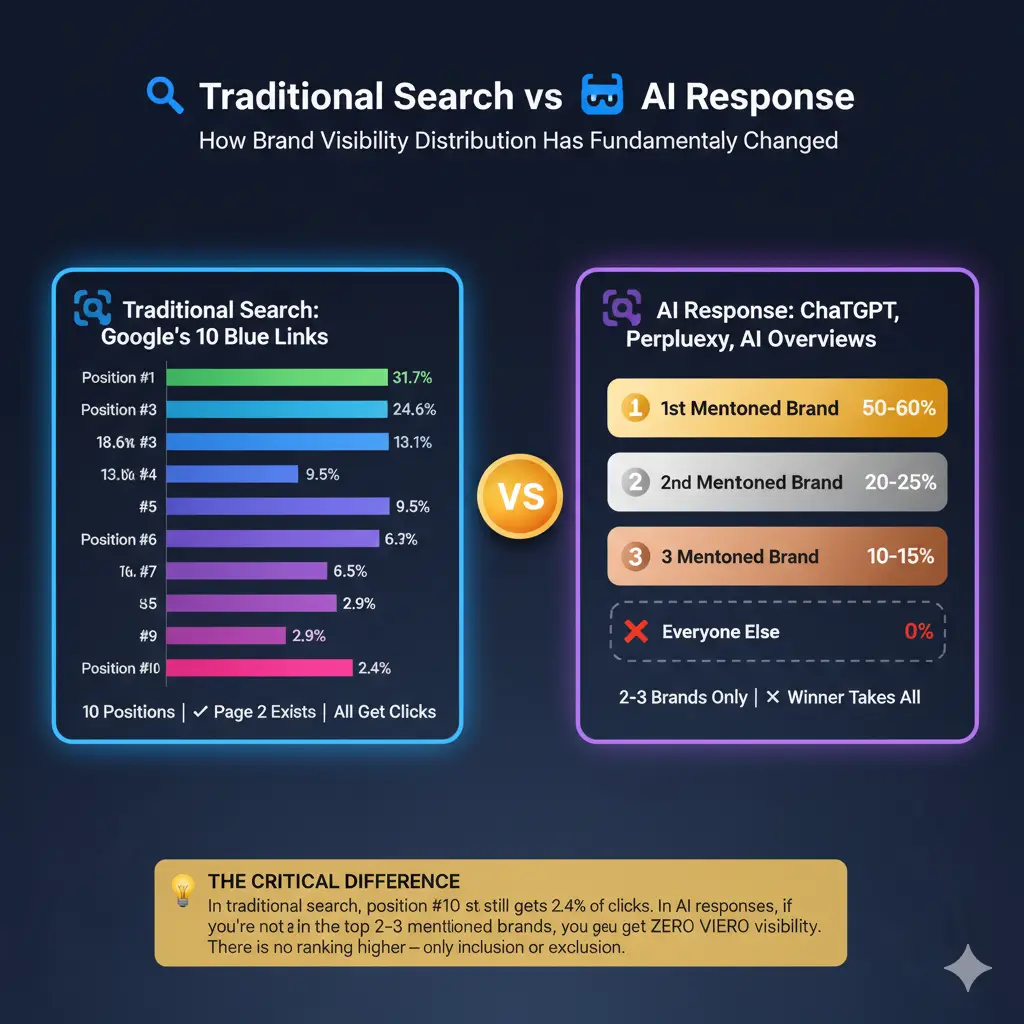
When someone asks ChatGPT “What’s the best project management tool?”, the AI doesn’t show a list of 10 options with your brand at position 7. It synthesizes information and recommends 2-4 tools by name. If you’re not mentioned, you received zero visibility. Not reduced visibility. Zero.
2. AI Responses Are Perceived as Expert Recommendations
Research from the Nielsen Norman Group shows users trust AI-generated recommendations similarly to trusted friend recommendations—significantly more than traditional ads or even organic search results. When ChatGPT says “Notion is excellent for team collaboration,” users treat this as an informed endorsement.
3. The Winner-Take-Most Dynamic
In traditional search, position 5 still gets clicks. In AI responses, the first-mentioned brand typically captures 50-60% of resulting actions. Brands mentioned second get 20-25%. Everyone else? Table scraps.
Real Example: The CRM Question
I ran this test across three AI platforms with the query: “What CRM should a 50-person B2B company use?”
🔍 AI Platform Brand Mention Analysis
Query: “What CRM should a 50-person B2B company use?”
Key Insight: Despite 100+ CRM options available, AI tools consistently mention only 4-5 brands. If you’re not in this rotation, you’re invisible to AI-influenced buyers.
Actionable takeaway: AI visibility isn’t about ranking higher—it’s about being in the conversation at all. Your first priority is determining whether you’re even being mentioned.
AI Visibility Data: How AI Is Reshaping Brand Discovery
The statistics clearly show why brands track AI visibility with increasing urgency. Let’s move beyond theory. Here’s what’s actually happening to brand discovery in 2026:
Traffic and Behavior Shifts
ChatGPT’s Scale:
- 100+ million weekly active users (OpenAI, 2024)
- Average session length: 8+ minutes (compared to 1-2 minutes for Google searches)
- 1 billion+ queries processed weekly
Perplexity’s Growth:
- 500+ million queries per month (up from 50M in early 2024)
- Average user performs 5-7 searches per session
- 60% of users report reducing Google usage after adopting Perplexity
Google AI Overviews Impact:
- Now appearing on 30%+ of U.S. searches (Search Engine Land, 2026)
- Click-through rates to organic results drop 30-40% when AI Overviews appear
- Mobile searches see even higher AI Overview frequency
The “Zero-Click” Problem Gets Worse
We already knew zero-click searches were rising—queries where users get answers directly from Google without clicking any result. AI accelerates this dramatically.
A study by SparkToro found:
- 58.5% of Google searches in the U.S. result in zero clicks (2024)
- When AI Overviews appear, this jumps to 74%
- For informational queries with AI responses, brand website clicks dropped by 65% on average
But here’s what most brands miss: Zero-click doesn’t mean zero impact.
When an AI Overview says “According to Nike, the best running shoes for marathon training combine cushioning with stability.Nike just received a brand impression worth potentially thousands in advertising value. They were cited as the authority. They shaped the user’s perception.
The question isn’t just “Am I getting clicks?” It’s “Am I being mentioned, cited, and recommended?”
Consumer Trust Shifts
Data from Edelman’s 2026 Trust Barometer reveals:
- 67% of Gen Z trusts AI recommendations for product research more than traditional review sites
- 54% of millennials have made a purchase based on an AI assistant’s recommendation
- 73% of users believe AI tools provide “unbiased” recommendations (despite evidence otherwise)
This perception of AI objectivity makes visibility even more valuable. Users think they’re getting neutral advice when AI recommends your competitor. They’re not questioning the source—they’re acting on it.
Actionable takeaway: Your brand is either being recommended or ignored while competitors capture “AI-influenced” conversions. Start measuring this channel like you measure organic, paid, and social.
How AI Visibility Works: Which Brands Get Recommended
Before you can improve AI visibility, you need to understand the black box (at least partially). How do ChatGPT, Perplexity, and Google’s AI decide which brands to mention?
The Three Pillars of AI Brand Selection
Pillar 1: Training Data Authority
Large Language Models like GPT-4 and Claude were trained on massive datasets—essentially snapshots of the internet up to their training cutoff dates.
What this means for brands:
- Content published before the training cutoff (varies by model) shaped the AI’s “knowledge”
- Brands with extensive, high-quality web presence during this period have embedded advantages
- Wikipedia pages, news coverage, and industry publications heavily influence brand “knowledge”
Example: If your brand had limited online presence before January 2024 (GPT-4’s approximate cutoff), ChatGPT may barely “know” you exist—regardless of your current marketing efforts.
Pillar 2: Retrieval-Augmented Generation (RAG)
Many AI tools don’t rely solely on training data. Perplexity, Bing Chat, and Google’s AI Overviews actively search the web and pull real-time information.
This retrieval process favors:
- Pages that rank well in traditional search (they’re more likely to be retrieved)
- Content with clear, structured answers to common questions
- Sources with established domain authority and credibility signals
- Recently updated, fresh content
This is why traditional SEO still matters. Strong organic rankings increase the likelihood your content gets retrieved and cited by AI tools.
Pillar 3: Entity Recognition and Knowledge Graphs
AI tools use entity databases—essentially digital encyclopedias of people, brands, concepts, and their relationships. Google’s Knowledge Graph is the most well-known example.
Brands with strong entity profiles benefit because:
- AI recognizes them as legitimate entities worth mentioning
- Their relationships to categories, products, and topics are understood
- They’re connected to authoritative sources and references
Weak entity presence = invisibility. If AI tools don’t recognize your brand as a significant entity in your category, you won’t be recommended—even if your product is superior.
🧠 How AI Selects Brands for Recommendations
The Three Pillars That Determine Your AI Visibility
PILLAR 1
Training Data Authority
Historical Knowledge Base
Wikipedia presence
News & media coverage
Academic references
Pre-cutoff content
PILLAR 2
Real-time Retrieval
RAG – Live Web Search
Current search rankings
Structured content
Fresh updated content
Domain authority
PILLAR 3
Entity Recognition
Knowledge Graph Position
Google Knowledge Panel
Entity associations
Brand verification
Wikidata presence
+
+
⚙️ AI Synthesis Engine
Combines all signals → Ranks credibility → Determines recommendation priority
✨ Final Output
🎯 Brand Recommendation
AI generates response mentioning only top 2-3 brands based on combined authority signals
🥇 1st Brand 50-60%
🥈 2nd Brand 20-25%
🥉 3rd Brand 10-15%
❌ Everyone Else 0%
💡
Key Takeaway
Weak entity presence = AI invisibility. If AI tools don’t recognize your brand as a significant entity in your category, you won’t be recommended — even if your product is superior. Build credibility across all three pillars to maximize your AI visibility.
What Actually Gets You Mentioned: The Credibility Stack
Based on analyzing thousands of AI responses across categories, here’s what correlates with brand mentions:This credibility framework shows why brands track AI visibility through third-party validation.
📊 What Gets Your Brand Mentioned by AI?
Credibility Factors That Influence AI Recommendations
Based on AI Response Analysis
Very High
High
Medium-High
Medium
Low-Medium
Very Low
💡
Key Insight
Notice what’s NOT on this list: your website’s blog posts about how great your product is. Self-promotional content rarely gets cited by AI tools. They’re looking for third-party validation — focus on Wikipedia, news coverage, and expert citations for maximum AI visibility.
Actionable takeaway: Audit your brand’s presence in AI-recognized authoritative sources—Wikipedia, news outlets, industry publications, and review sites. This “credibility stack” determines whether AI will recommend you.
Why Brands Must Track AI Visibility: The Business Case:
The ROI data demonstrates why brands must track AI visibility as a revenue-critical activity. We’re focused on proven channels right now. This is the most common objection I hear from brand leaders. Here’s why it’s shortsighted.
The Cost of Invisibility: A Calculation
Let’s run real numbers for a hypothetical B2B software company:
Scenario:
- Category: Project Management Software
- Monthly category searches (Google): 500,000
- Estimated AI-influenced research queries (ChatGPT, Perplexity, etc.): 75,000/month
- Average customer lifetime value: $5,000
- Conversion rate from AI recommendation to trial: 3%
- Trial to customer conversion: 20%
If you’re mentioned in AI responses:
- 75,000 queries × 15% click-through rate = 11,250 visits
- 11,250 × 3% = 338 trial signups
- 338 × 20% = 68 new customers/month
- 68 × $5,000 LTV = $340,000 monthly value
If you’re NOT mentioned:
- Impact: $0 from this channel (or worse—customers go to competitors)
Annual difference: $4+ million in customer value
Now consider: These numbers are conservative. They don’t account for brand awareness effects, reduced customer acquisition costs, or competitive displacement.
The Compounding Problem
AI visibility isn’t static. It’s reinforcing.
When Brand A gets recommended repeatedly:
- More users try Brand A
- More people write about Brand A
- More mentions appear across the web
- AI’s training data becomes richer with Brand A references
- AI recommends Brand A even more
Meanwhile, Brand B (not being recommended):
- Loses potential customers to Brand A
- Gets less coverage and fewer reviews
- Falls further behind in AI recognition
- The visibility gap widens over time
This is a flywheel—and you’re either on it or being crushed by it.
The First-Mover Window Is Closing
Right now, most brands aren’t tracking AI visibility. Even fewer are actively optimizing for it. This creates a temporary opportunity.
The brands establishing AI visibility now will:
- Build foundational advantages in training data for future models
- Accumulate citations and mentions that reinforce their position
- Develop operational expertise in an emerging discipline
In 2-3 years, catching up will be significantly harder and more expensive.
Actionable takeaway: Calculate your category’s AI-influenced query volume and the customer value you’re missing. Present this as a revenue risk, not a marketing experiment.
How to Track AI Visibility: Methods and Tools
You’re convinced AI visibility matters. Now, how do you actually measure it?
Challenge: AI Tracking Is Harder Than Traditional Analytics
Unlike Google searches (tracked via Search Console) or website traffic (tracked via GA4), AI platforms don’t provide native brand analytics. You can’t log into ChatGPT and see “Your brand was mentioned 5,000 times this month.”
This means tracking requires a combination of manual audits, third-party tools, and proxy metrics.
Method 1: Manual Query Testing (Foundation)
What it is: Regularly querying AI platforms with category-relevant prompts and documenting whether your brand appears.
How to implement:
- Build a query bank of 50-100 prompts your target customers might ask
- “What’s the best [category] for [use case]?”
- “Compare [type of product] options”
- “[Problem] — what should I try?”
- “Recommend a [product] for [specific need]”
- Establish a testing cadence (weekly or bi-weekly)
- Document results systematically:
📋 AI Query Tracking Template
Document your brand’s AI visibility across platforms
📊 AI Share of Voice Formula:
(Mentions of your brand ÷ Total queries tested) × 100 = AI Share of Voice %
- Calculate your AI Share of Voice:
- (Mentions of your brand / Total queries tested) × 100 = AI Share of Voice %
Limitations: Manual testing is time-intensive, doesn’t scale well, and represents a sample—not complete data.
Best for: Smaller brands, initial baseline establishment, competitive intelligence
Method 2: AI Visibility Monitoring Platforms (Emerging)
Several tools now specialize in tracking brand mentions across AI platforms:
Profound (getprofound.ai)
- Tracks brand mentions across ChatGPT, Perplexity, Claude, Gemini
- Provides share of voice metrics against competitors
- Monitors sentiment of AI-generated mentions
- Pricing: Starts ~$500/month
Brandwatch AI Monitoring
- Enterprise-level AI conversation tracking
- Integrates with broader social listening
- Custom query tracking
- Pricing: Enterprise custom
Originality.ai Brand Tracker
- Focuses on AI citation tracking
- Identifies which sources AI pulls from
- Useful for understanding attribution
- Pricing: Mid-market
Semrush AI Visibility (Beta)
- Integrates with existing SEO workflows
- Tracks AI Overview appearances
- Competitive AI visibility benchmarking
- Pricing: Included in enterprise tiers
🛠️ AI Visibility Tracking Tools Comparison
Find the right tool to monitor your brand’s AI presence
💡
Our Recommendation
Start with Manual Audits (free) to establish your baseline. Once you’ve validated AI visibility as a priority, upgrade to Profound for comprehensive tracking or Semrush if you’re already using it for SEO.
Budget-Friendly
Mid-Range
Enterprise
Best for: Mid-size to enterprise brands, agencies managing multiple clients, ongoing monitoring programs
Method 3: Proxy Metrics From Existing Analytics
While not direct measurement, these proxy metrics indicate AI visibility performance:
A) AI-Referred Traffic in GA4
Users who click links in AI responses can be identified:
- Check referral traffic from “perplexity.ai” (direct referrer)
- ChatGPT clicks often appear as direct traffic (harder to isolate)
- Google AI Overview clicks show in Search Console with modified dimensions
Setup: Create a segment in GA4 for known AI referrers and monitor growth.
B) Branded Search Volume Growth
Strong AI visibility drives branded searches (users hear about you via AI, then Google your brand name). Monitor:
- Google Trends for your brand name
- Search Console branded query impressions
- Week-over-week and month-over-month changes
C) Citation Tracking via Alerts
Set up alerts for when AI-cited sources mention your brand:
- Google Alerts for “[brand name] + [major publication]”
- Monitor Perplexity’s cited sources for your brand appearances
- Track academic and research database mentions
Method 4: Competitive AI Audits
Understanding competitor visibility helps contextualize your position:
- Run 25-50 queries across your category
- Document every competitor mention (not just your brand)
- Calculate competitor AI Share of Voice
- Identify patterns: Which competitors dominate? For which query types?
Output: A competitive AI visibility map showing where you lead, lag, and have opportunities.
[IMAGE: Sample competitive AI visibility matrix — showing Brand A, B, C performance across query categories]
What Metrics Actually Matter
Not all AI visibility is equal. Prioritize these metrics:
📊 Key AI Visibility Metrics to Track
Not all AI visibility is equal. Prioritize these metrics:
How to Improve Your Brand’s AI Visibility
Improving your AI visibility is a compound strategy that combines content optimization with credibility building.Tracking visibility is step one. Improving it is the goal. Here’s the strategic framework for increasing your brand’s presence in AI-generated recommendations.
Strategy 1: Build the Credibility Stack
AI tools recommend brands with third-party validation. Your job is to accumulate credible mentions:
Wikipedia Presence
- If notable, ensure a Wikipedia page exists and is accurate
- If not page-eligible, ensure your brand is mentioned on relevant category/topic pages
- Do NOT edit Wikipedia yourself—this violates policies and can backfire
News and Media Coverage
- Pursue earned media aggressively
- Publish newsworthy announcements, research, and data
- Build relationships with industry journalists
- Target publications AI tools frequently cite
Industry Recognition
- Apply for relevant industry awards
- Seek inclusion in analyst reports (Gartner, Forrester, G2)
- Participate in industry research and benchmarking
Expert and Influencer Validation
- Partner with recognized experts for endorsements
- Guest on industry podcasts (transcripts create citable content)
- Collaborate on thought leadership pieces
Review Platform Presence
- Encourage customer reviews on authoritative platforms
- Maintain strong ratings (AI tools notice sentiment)
- Respond to reviews professionally
Timeframe: This is a 6-12 month strategy. Credibility isn’t built overnight.
Strategy 2: Optimize Owned Content for Retrieval
AI tools that use retrieval (Perplexity, Google AI, Bing) pull from web content. Optimize for this:
Structure Content for AI Parsing
- Use clear headings that match common questions
- Provide direct, concise answers in the first 1-2 sentences
- Use structured data (FAQ schema, How-To schema, Product schema)
- “According to [Your Brand]…” statements AI can quote
Brands that optimize for featured snippets and voice search often see improved AI visibility as well, since similar principles apply clear answers, structured data, and authoritative content.
Target “Best” and “Comparison” Queries
- Create definitive comparison guides in your category
- Include your brand naturally within objective comparisons
- Update content regularly to ensure freshness
- Build Topical Authority
Build Topical Authority
- Cover your category comprehensively (topical authority signals)
- Interlink related content to create topic clusters
- Become the “go-to” resource AI would logically cite
AI tools that use retrieval (Perplexity, Google AI, Bing) pull from web content. Optimize for this:
Structure Content for AI Parsing
- Use clear headings that match common questions
- Provide direct, concise answers in the first 1-2 sentences
- Use structured data (FAQ schema, How-To schema, Product schema)
- Include “According to [Your Brand]…” statements AI can quote
Target “Best” and “Comparison” Queries
- Create definitive comparison guides in your category
- Include your brand naturally within objective comparisons
- Update content regularly to ensure freshness
Build Topical Authority
- Cover your category comprehensively (topical authority signals)
- Interlink related content to create topic clusters
- Become the “go-to” resource AI would logically cite
Platform-Specific Strategies
Platform differences highlight why brands track AI visibility across multiple AI tools simultaneously.. Not all AI platforms work the same way. Here’s how to approach the major players:
ChatGPT (OpenAI)
How it works:
- Primarily relies on training data (knowledge cutoff)
- Newer versions (GPT-4 with browsing) can access real-time web
- Default behavior is no browsing—relies on existing knowledge
Optimization priorities:
- Historical web presence (what existed before training cutoff)
- Wikipedia and high-authority site mentions
- Newsworthy coverage that becomes training data
- Patience—new content takes time to enter future training sets
What to track:
- Mentions in standard queries (non-browsing mode)
- How you’re characterized when mentioned
- Competitive position in category queries
Perplexity
How it works:
- Real-time search and retrieval
- Cites sources directly in responses
- Combines multiple sources for answers
Optimization priorities:
- Traditional SEO (ranking content gets retrieved)
- Structured, clear content with direct answers
- Freshness and regular updates
- Being cited by sources Perplexity trusts
What to track:
- Citation rate (are your pages cited as sources?)
- Mention frequency
- Which competitors’ content gets cited vs. yours
Google AI Overviews (SGE)
How it works:
- Pulls from Google’s existing index and Knowledge Graph
- Prioritizes authoritative, fresh content
- Links to source pages within overviews
Optimization priorities:
- Strong traditional SEO fundamentals
- Featured snippet optimization (similar methodology)
- Schema markup for entity clarity
- E-E-A-T signals (Experience, Expertise, Authority, Trust)
What to track:
- AI Overview appearances for target queries
- Click-through rates to your site from AI Overviews
- Visibility changes over time
Claude (Anthropic)
How it works:
- Primarily training data based
- Strong emphasis on accuracy and sourcing
- More cautious about recommendations
Optimization priorities:
- Similar to ChatGPT—historical presence matters
- Academic and research-based content
- Clear, factual information
What to track:
- Mention quality and accuracy
- How you’re compared to competitors
Microsoft Copilot (Bing Chat)
How it works:
- Combines GPT with real-time Bing search
- Cites sources actively
- Tightly integrated with Microsoft ecosystem
Optimization priorities:
- Bing SEO (often overlooked)
- Microsoft platform presence (LinkedIn mentions matter more)
- Structured data and schema
- News coverage (Bing News feeds into Copilot)
What to track:
- Bing search visibility (influences Copilot retrieval)
- Citation rate in Copilot responses
🤖 AI Platform Comparison
How each platform works differently
Training = Historical data
Retrieval = Live search
Actionable takeaway: Match your strategy to the platform. Prioritize Perplexity if you’re strong in SEO; focus on credibility building if you need to influence training-data-based tools like ChatGPT.
Case Studies: AI Visibility in Action
Let’s examine how AI visibility plays out in real scenarios:
Case Study 1: The SaaS Company That Disappeared
Situation: A mid-size project management SaaS company (let’s call them “TaskFlow”) noticed declining organic leads despite stable Google rankings. Their SEO team couldn’t explain the drop.
Investigation: They ran an AI visibility audit across 100 category queries.
Findings:
- Mentioned in only 4% of ChatGPT queries about project management
- Perplexity cited competitors 5x more frequently
- Google AI Overviews showed them in 0 of the top 20 target queries
Root cause: TaskFlow had limited Wikipedia presence (no page, brief mention on a comparison page). Their media coverage was sparse—mostly self-published press releases. Competitors had robust third-party validation.
Action taken:
- Launched a PR campaign targeting industry publications
- Published original productivity research that earned news coverage
- Updated all owned content for structured data and clear answer formatting
- Applied for and won industry awards to build credibility
Results (6 months later):
- AI visibility rose to 23% of tested queries
- Perplexity citations increased 4x
- Lead volume returned to previous levels, then grew 15% beyond
Lesson: Even brands with strong traditional SEO can become invisible in AI channels if they lack third-party credibility signals.
Case Study 2: The Startup That Won Visibility Early
Situation: A B2B cybersecurity startup (“SecureShield”) launched in 2023 with limited budget. They couldn’t outspend competitors in paid advertising or SEO.
Strategy: They invested heavily in AI visibility from day one:
- Founder became an active source for cybersecurity journalists
- Published 4 original research reports in year one
- Created comprehensive, structured content answering every common question
- Built partnerships with recognized security organizations
Results (18 months):
- Mentioned in 31% of ChatGPT cybersecurity queries (vs. 12% average for competitors)
- Perplexity cited their research in 200+ responses monthly
- 22% of new leads reported discovering them via AI recommendations
Lesson: Early investment in AI visibility can leapfrog established competitors who haven’t adapted.
Case Study 3: The E-Commerce Brand’s Recovery
Situation: A DTC skincare brand (“GlowLab”) saw AI Overviews appearing on 80% of their target skincare queries. Click-through to their product pages dropped 40%.
Response: Rather than fighting AI Overviews, they optimized to appear within them:
- Restructured product pages with FAQ schema for common questions
- Earned dermatologist endorsements and expert quotes
- Created ingredient education content that got cited as authoritative
- Encouraged customer reviews on AI-recognized platforms
Results:
- Appeared in 15% of relevant AI Overviews within 4 months (up from 0%)
- Recovered 60% of lost traffic through AI Overview clicks
- Brand search volume increased 25% (visibility drove awareness)
Lesson: AI Overviews are unavoidable. The solution is inclusion, not resistance.
Actionable takeaway: These case studies share a common thread: brands that treat AI visibility as a strategic priority—and invest in building third-party credibility—outperform those treating it as an afterthought.
Common Mistakes Brands Make With AI Visibility
Avoid these pitfalls as you build your AI visibility strategy:
Mistake 1: Thinking AI Visibility = Traditional SEO
Yes, SEO influences AI visibility (especially for retrieval-based tools). But they’re not the same.The difference: SEO optimizes for ranking signals (links, content, technical factors). AI visibility requires credibility signals (entity authority, third-party mentions, knowledge base presence).A site ranking #1 for a keyword might never appear in AI responses if it lacks the credibility markers AI tools look for.
Mistake 2: Only Tracking Direct Traffic
“We don’t see traffic from ChatGPT, so it must not matter.”
This ignores:
- Brand awareness effects (users see your name, then Google it later)
- Perplexity traffic (which does show as referral)
- AI Overviews (clicks credited to Google)
- Offline conversions (B2B buyers researching via AI)
Track brand search volume, not just referral traffic.
Mistake 3: Self-Promotional Content Focus
AI tools rarely cite “Why [Your Brand] Is The Best” blog posts. They cite:
- Objective comparisons
- Expert analysis
- Research and data
- Educational content
Stop creating content about how great you are. Start creating content that’s genuinely useful—and happens to include your expertise.
Mistake 4: Ignoring Competitors
You can’t optimize AI visibility in a vacuum. AI gives recommendations that are relative—”Brand A is good for X, while Brand B is better for Y.”If competitors dominate AI mentions, your visibility strategy needs to account for differentiation, not just presence.
Mistake 5: Expecting Immediate Results
AI visibility improvement takes time because:
- Training data updates are periodic (not real-time)
- Credibility stacking is gradual
- Entity recognition builds over time
Realistic timeline: Expect 3-6 months for initial improvements, 12+ months for significant visibility shifts.
Mistake 6: Over-Indexing on One Platform
ChatGPT gets attention, but don’t ignore:
- Perplexity (growing rapidly, especially among researchers)
- Google AI Overviews (massive reach)
- Claude (increasingly popular in professional settings)
- Microsoft Copilot (enterprise integration)
Diversify your AI visibility strategy across platforms.
Actionable takeaway: AI visibility requires a different mindset than traditional marketing. Focus on credibility over promotion, measure beyond direct traffic, and play the long game.
Tools and Resources for AI Visibility
🛠️ Tools & Resources for AI Visibility
Monitoring your AI visibility requires a combination of manual audits, third-party tools, and proxy metrics.
Everything you need to track, optimize, and dominate AI search
📊
AI Visibility Tracking Tools
🏢
Entity & Knowledge Graph Tools
📰
Digital PR & Credibility Tools
📚
Learning Resources
Courses
Kevin Indig’s “Growth Memo” covers AI visibility regularly
Newsletters
Search Engine Land & Search Engine Journal for AI search updates
Communities
LinkedIn AI SEO groups & Reddit r/seo
💡
Actionable takeaway: Start with manual audits and free tools. Graduate to paid monitoring as AI visibility becomes a proven revenue driver for your brand.
Frequently Asked Questions
These FAQs address common questions about why brands must track AI visibility in today’s market.
❓ Frequently Asked Questions
Everything you need to know about AI visibility
🚀 AI Visibility Roadmap: Your Action Plan
This action plan shows why brands must track AI visibility and how to start immediately.
Turn knowledge into action with this step-by-step timeline
Baseline Assessment
Run 50 test queries across ChatGPT, Perplexity, and Google AI
Document current visibility rate and competitive position
Audit your brand’s Wikipedia presence and third-party mentions
Check referral traffic from AI platforms in GA4
Foundation Building
Implement structured data (FAQ, Organization, Product schema)
Identify 10 target queries where you want to appear
Optimize existing content for clear, direct answer formatting
Set up ongoing tracking (manual or via tool)
Credibility Expansion
Launch PR initiative for news coverage
Publish original research or data study
Apply for relevant industry awards
Build expert commentary opportunities
Create comprehensive comparison and guide content
Monitor & Iterate
Monthly visibility audits
Quarterly competitive analysis
Test new query categories
Adjust strategy based on results
🎯 Start today: Run your first 10 test queries on ChatGPT and document whether your brand appears. That’s your baseline—now build from there!
Conclusion: AI Visibility Is Not Optional Anymore
Now you fully understand why brands track AI visibility in the AI-first search era.
🚀 Take Action Now
Start Tracking Your AI Visibility Today
The brands that understand why brands must track AI visibility today will dominate their markets tomorrow.
📚 Continue Learning About AI Visibility